Current
Enterprise Twin
Active pilot in a live workflow

An applied research line on representing operations as calibrated, simulatable models.
Current
Active pilot in a live workflow
Proposed
Collaborative R&D initiative; consortium forming
Seeking
Financial institutions, network researchers and industrial data partners
The research line
A heterogeneous agent with typed, conserved accounts, populated from the event log the operation actually writes.
Fitting heterogeneous-agent models to data, and choosing methods by held-out performance.
Supplier shocks that become liquidity and credit outcomes, with uncertainty kept in the reconstruction.
Research
Representing a firm as typed, conserved accounts connected by declared interactions, where quantities change only through balanced postings and model parameters are estimated from the firm's own event log rather than assumed. The aim is a model that tracks an operation rather than describing an intention.
Empirical calibration of heterogeneous-agent models. The hard problem is not building a simulation: it is fitting one to data as dimensionality and scale grow, and knowing which approach actually wins on held-out statistics.
Supplier and customer shocks do not stay local. They move through production networks into output, liquidity and default outcomes. Modelling that requires firm-level resolution, honest treatment of the uncertainty in a reconstructed network, and scenario propagation that a decision-maker can interrogate.
Operational modelling usually happens at some distance from the operation itself. We work in both places: the team has operated commerce businesses, deployed systems into live workflows, and brings a research background in computational finance, agent-based modelling and machine learning.
The difference shows up in what we assume about the data. A model of a firm that cannot be populated from what the firm actually records is not a model anyone will use. Knowing what an operation records, what it records badly, and what it never writes down at all is the kind of thing you learn from the inside. Our systems and our research both start there: with the evidence that exists, the constraints that bind, and the exceptions nobody documented.
Proposed Collaborative R&D Initiative
FIN-TWIN is a named proposal for collaborative R&D, not a started or funded project. It would investigate how incomplete firm and financial data can be transformed into uncertainty-aware network models, empirically calibrated simulations and explainable shock scenarios with relevance to early warning and portfolio risk.
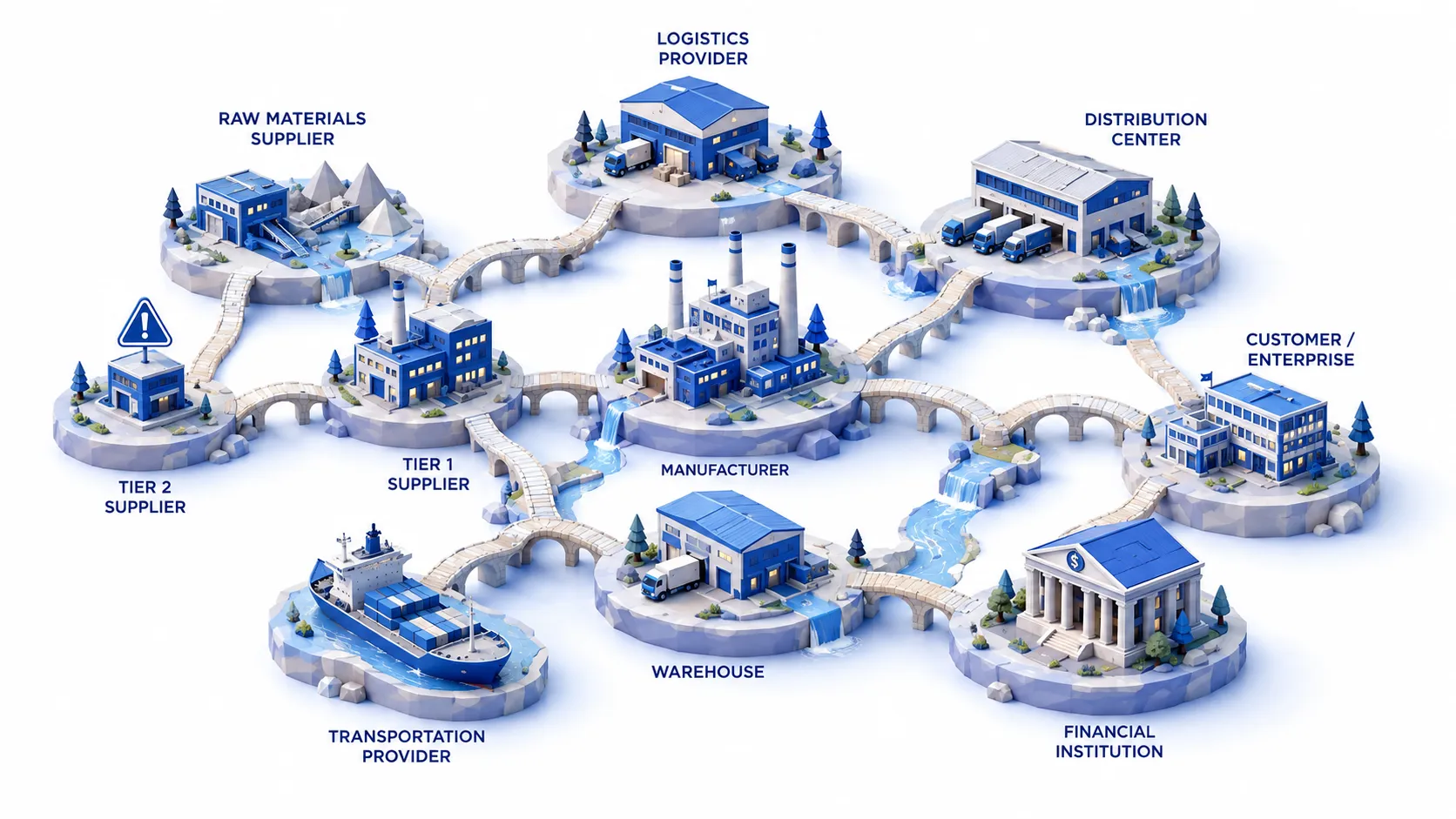
Firm-to-firm networks are rarely observed completely. Reconstruction methods produce plausible networks, but a single inferred network presented as truth is the wrong object for a credit decision. FIN-TWIN would investigate how reconstruction uncertainty can be retained and propagated rather than discarded.
Turning economic evidence and microdata into machine-actionable behavioural specifications, with every structure traceable to its source, so that a calibrated model can be audited rather than simply trusted.
Fitting heterogeneous firm and bank behaviour against micro distributions, accounting identities and network moments simultaneously, and selecting methods by measured performance rather than architectural preference.
Moving from an event to production and liquidity effects to financial outcomes, with explainable paths and uncertainty bands rather than a single number.
Anyone who has run a commerce operation has watched a single supplier problem travel. A late input becomes a missed production window, becomes a cash gap, becomes a payment that arrives late somewhere else entirely. Each firm sees its own link in that chain and very little beyond it. Financial institutions often receive fragmented or lagged views of these relationships, while each firm sees only its own part of the chain. The open problem is not whether these effects exist: it is building something operational on top of the incomplete data that firms and financial institutions actually hold.
We are developing international partnerships and consortium opportunities around this work for collaborative R&D and innovation funding programmes.
This is collaborative research, not a product for sale. We are not offering a regulatory model, and nothing here is a decision-making system for credit. The intended outputs are decision support, evaluated against stated baselines.
Applied R&D
Public product - liveRetail Labs Studio is the public surface of an applied research stack: virtual try-on, garment-aware generation, and the structured catalogues those models train on. Start from what the data actually contains, then build something that runs. That habit is what we bring to operational modelling; it is not the same problem.
Models for virtual try-on and garment understanding, trained on our catalogues and running in Studio.
Typed attributes and a fashion ontology derived from large product-image databases, so a catalogue is a structured object, not a folder of files.
Cleaning, enrichment and analysis pipelines that run across millions of entries.
If you are assembling a consortium, evaluating a work package, or working on adjacent problems, we would like to talk.
Contact the research team